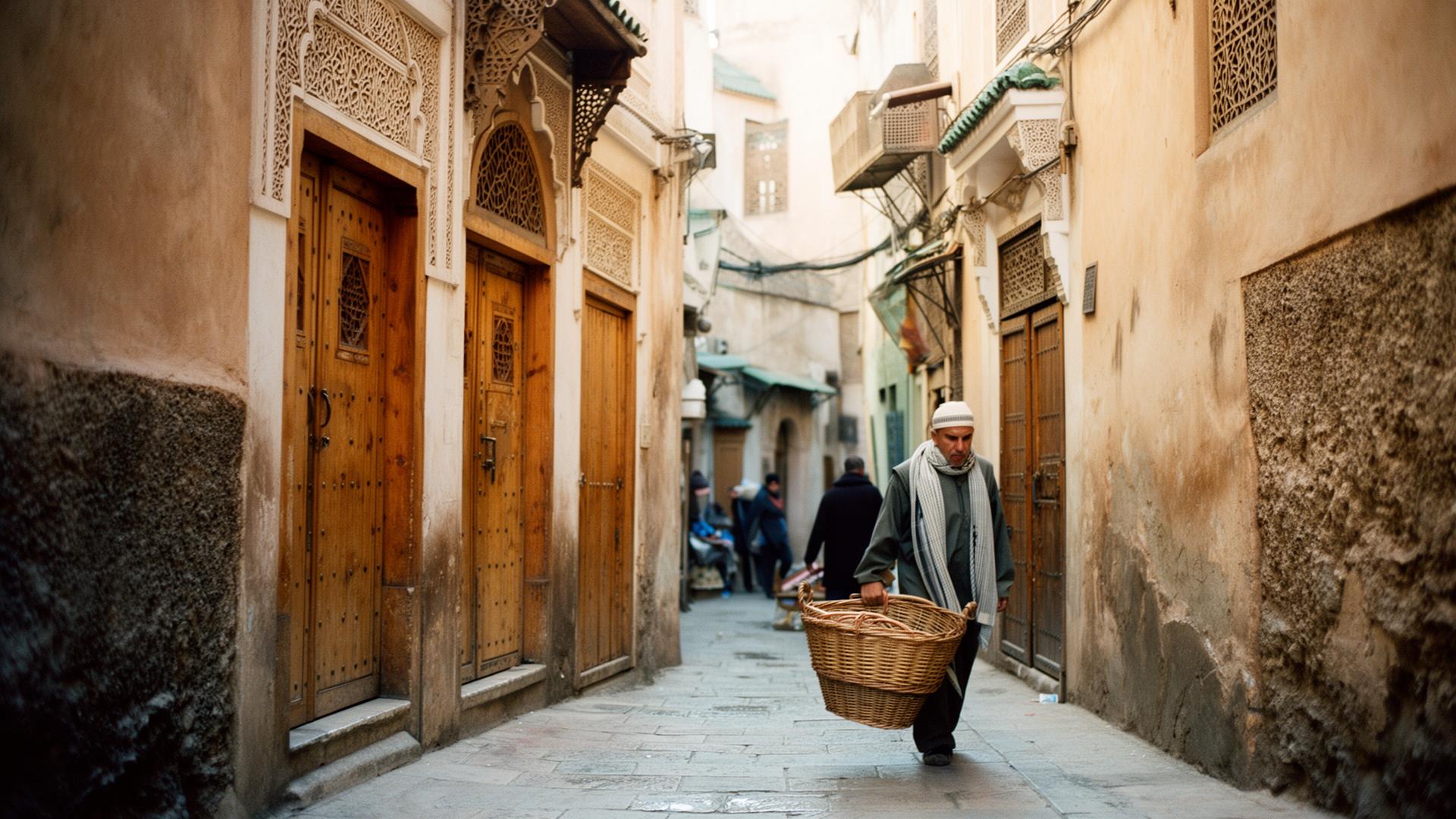
Meknes — the fourth of Morocco's imperial cities and the least visited — rewards the traveller who lingers: a UNESCO medina, the monumental gates and granaries of Sultan Moulay Ismail's 17th-century capital, and the Roman city of Volubilis 33 km to the north.
In this guide
What is Bab Mansour and why is it significant?
Bab Mansour el-Aleuj — completed in 1732 under Sultan Moulay Ismail — is one of the most imposing triumphal gates in the Islamic world. Named after its architect, a Christian convert, its facade is covered in a complex of carved zellij tilework, Corinthian columns taken from the Roman ruins of Volubilis, and carved stucco panels. Its proportions are deliberately grandiose: the gate was intended to project the power of Moulay Ismail's new capital, which at its height was said to rival Versailles in extent and ambition.
The gate opens onto the Place el-Hedim — the main square of Meknes, a calmer echo of Marrakech's Jemaa el-Fnaa with musicians, henna artists and produce sellers but without the commercial intensity of the tourist-industry equivalent. The Dar Jamai museum, housed in a 19th-century vizier's palace on the square, holds a superb collection of Meknes-region crafts: embroidery, ceramics (the distinctive polychrome Meknes geometric pattern), jewellery and carved woodwork.
- Bab Mansour el-Aleuj — 18th-century triumphal gate; finest in Morocco; UNESCO-listed medina.
- Place el-Hedim — the main square; calmer version of Jemaa el-Fnaa.
- Dar Jamai museum — vizier's palace; regional crafts including Meknes-style polychrome ceramics.
- Medina souks — less touristed than Marrakech; good prices on embroidery and local pottery.
- Heri es-Souani — the former royal granary and stables; engineering achievement of the 17th century.
- Mausoleum of Moulay Ismail — active royal mausoleum; one of the few open to non-Muslims in Morocco.
What is Heri es-Souani and the Moulay Ismail imperial complex?
Heri es-Souani — the royal granary and stable complex built by Moulay Ismail in the late 17th century — is one of the most striking architectural achievements of the Alaoui dynasty. The granary consists of a vast series of vaulted storage chambers, built with massive walls (over 2 m thick) designed to maintain a constant cool temperature regardless of the desert heat outside; the scale of the construction reflects a court that was reputed to house 12,000 horses. Much of the roof has collapsed, creating a ruined grandeur — great barrel-vaulted stone chambers open to the sky, with the original underground cisterns still visible below.
The Agdal basin — an enormous ornamental lake beside the granary — was created to supply the palace complex with water and to provide a picturesque setting for royal recreation. It is one of the largest man-made reservoirs of the pre-industrial Islamic world. The surrounding walls of Moulay Ismail's imperial city (kasbah) stretch for 40 km — most are still standing — and can be followed on foot or by bicycle for a sense of the city's original scale.
What is Volubilis and how do you visit it?
Volubilis is the best-preserved Roman city in Morocco and one of the finest in North Africa. Located 33 km north of Meknes near the village of Moulay Idriss Zerhoun, the site was a prosperous Roman provincial capital (Municipium Volubilitanum) from the 1st century BC to the 3rd century AD, later an Islamic centre in the 8th century before being largely abandoned. UNESCO World Heritage status since 1997 has supported ongoing excavation and conservation.
The site's highlights are the mosaics — remarkably well-preserved polychrome floor mosaics in the townhouses depicting Orpheus, Dionysus, the labours of Hercules and mythological scenes; some of the finest Roman mosaics surviving in any context. The Capitoline Temple, the Triumphal Arch of Caracalla (completed 217 AD), the basilica and the decumanus maximus (main street) are all clearly readable. Allow 2–3 hours with a guide; a guide (MAD 120–200) adds considerably to the experience.
Moulay Idriss Zerhoun — the holy city immediately adjacent to Volubilis — is the site of the mausoleum of Moulay Idriss I, the founder of the Idrisid dynasty and of the Moroccan nation as an Islamic state. It was closed to non-Muslims until 2005; it is now open, though visitors should be respectful and modest in dress. The view of Volubilis from the Moulay Idriss hillside at sunset is one of the great Moroccan landscapes.
- Volubilis mosaics — Orpheus, Dionysus, Hercules labours; some of the best-preserved Roman mosaics anywhere.
- Triumphal Arch of Caracalla — completed 217 AD; still largely intact.
- Capitoline Temple — 2nd century AD; platform visible from the main approach road.
- Moulay Idriss Zerhoun — holy city adjacent; mausoleum of Morocco's founding Idrisid ruler.
- Entry to Volubilis: approximately MAD 70; guide MAD 120–200 recommended.
What is the medina of Meknes like compared with Fes?
Meknes medina is UNESCO-listed and genuinely historic, but it is considerably more manageable than Fes el-Bali — less labyrinthine, less dense and much less dominated by tourist commerce. The souks around Place el-Hedim concentrate the main craft production: the embroidery souk (silk thread on cotton in geometric Meknes patterns), the pottery souk (the characteristic polychrome blue-and-green palette of Meknes distinct from the blue-on-white of Fes), and the covered souk for leatherwork, carpets and silverware.
The relative quiet makes Meknes particularly attractive for those who found Fes's medina overwhelming. Prices in the souks reflect a smaller tourist economy: bargaining is still expected, but the baseline is lower and the pressure significantly lighter. The medina can be comfortably explored in half a day; a full day includes the imperial kasbah and Heri es-Souani.
How long should you spend in Meknes and how do you get there?
Meknes is 60 km west of Fes on the ONCF train line — 45 minutes by train, with frequent services. From Rabat, 130 km west, the journey takes approximately 2 hours. This proximity means Meknes is most commonly visited as a day trip from Fes, combining Volubilis and Moulay Idriss in a full-day excursion. However, one night in Meknes — allowing a morning in the medina, an afternoon at Volubilis at golden hour, and an evening on Place el-Hedim — is a qualitatively better experience than the day-trip rush.
- From Fes: train, 45 minutes, frequent services.
- From Rabat: train, approximately 2 hours.
- From Casablanca: train via Rabat, approximately 3 hours.
- Recommended stay: 1 night minimum to combine medina and Volubilis properly.
Frequently asked
Is Meknes worth visiting in Morocco?
Yes — particularly for travellers who want an imperial city experience without the tourist intensity of Marrakech or Fes. Meknes offers Bab Mansour (one of Morocco's finest monuments), a manageable medina, and Volubilis (the best Roman ruins in North Africa) within 30 minutes. It is an underrated city that rewards a night rather than just a transit.
What is Meknes famous for?
Meknes is famous primarily as the capital of Sultan Moulay Ismail (reigned 1672–1727), who built a city of monumental scale intended to rival the courts of Louis XIV. Bab Mansour gate, the Heri es-Souani granary and the 40 km of imperial walls are his legacy. The city is also the nearest urban base for Volubilis, Morocco's finest Roman archaeological site.
How far is Volubilis from Meknes?
Volubilis is 33 km north of Meknes, approximately 30–40 minutes by car. The holy city of Moulay Idriss Zerhoun is adjacent to the site and is typically combined in the same excursion. Organised day trips from Fes (60 km) combine Meknes, Volubilis and Moulay Idriss in a single long day.
Can non-Muslims visit the Mausoleum of Moulay Ismail?
Yes — the Mausoleum of Moulay Ismail in the heart of the Meknes imperial kasbah is one of the few active royal mausoleums in Morocco open to non-Muslim visitors. Modest dress (covered shoulders and knees) is required; shoes are removed at the threshold. Entry is free.
What is the best time to visit Meknes?
Spring (March–May) and autumn (September–November) are ideal for Meknes and the Volubilis site — comfortable temperatures (15–25°C) and good light for the mosaics. Summer is hot (35–38°C); visit Volubilis early morning and retreat to the shaded souks by midday. Winter is mild and uncrowded; the Volubilis site is particularly beautiful in the low winter light.
Planning a trip?
Let a Marrakech atelier handle the details.
Tell us your dates and style and we'll send a written itinerary and a transparent quote within 24 hours.
Request an itineraryKeep reading
Planning
Things to Do in Fes: The Essential Guide
Fes el-Bali is the world's largest inhabited medieval city — a UNESCO World Heritage medina of 9,400 lanes, 14th-century madrasas, the planet's oldest university and the Chouara tanneries. It demands a good guide, unhurried time and genuine curiosity.
Planning
Things to Do in Rabat: The Essential Guide
Rabat, Morocco's understated capital, rewards visitors with UNESCO-listed monuments, a royal kasbah, Roman ruins and a genuine daily-life rhythm entirely free from the tourist pressure of Marrakech or Fes.
Itineraries
Morocco Itinerary: 10 Days
Ten days is the sweet spot for Morocco — long enough to combine Marrakech, the Sahara and the imperial north in one unhurried loop, with the coast as an optional finish.
Itineraries
Morocco Itinerary: 7 Days
A week is enough to pair Marrakech with the Sahara, or to trace the imperial cities of the north. Here are two proven 7-day Morocco itineraries — and how to choose between them.