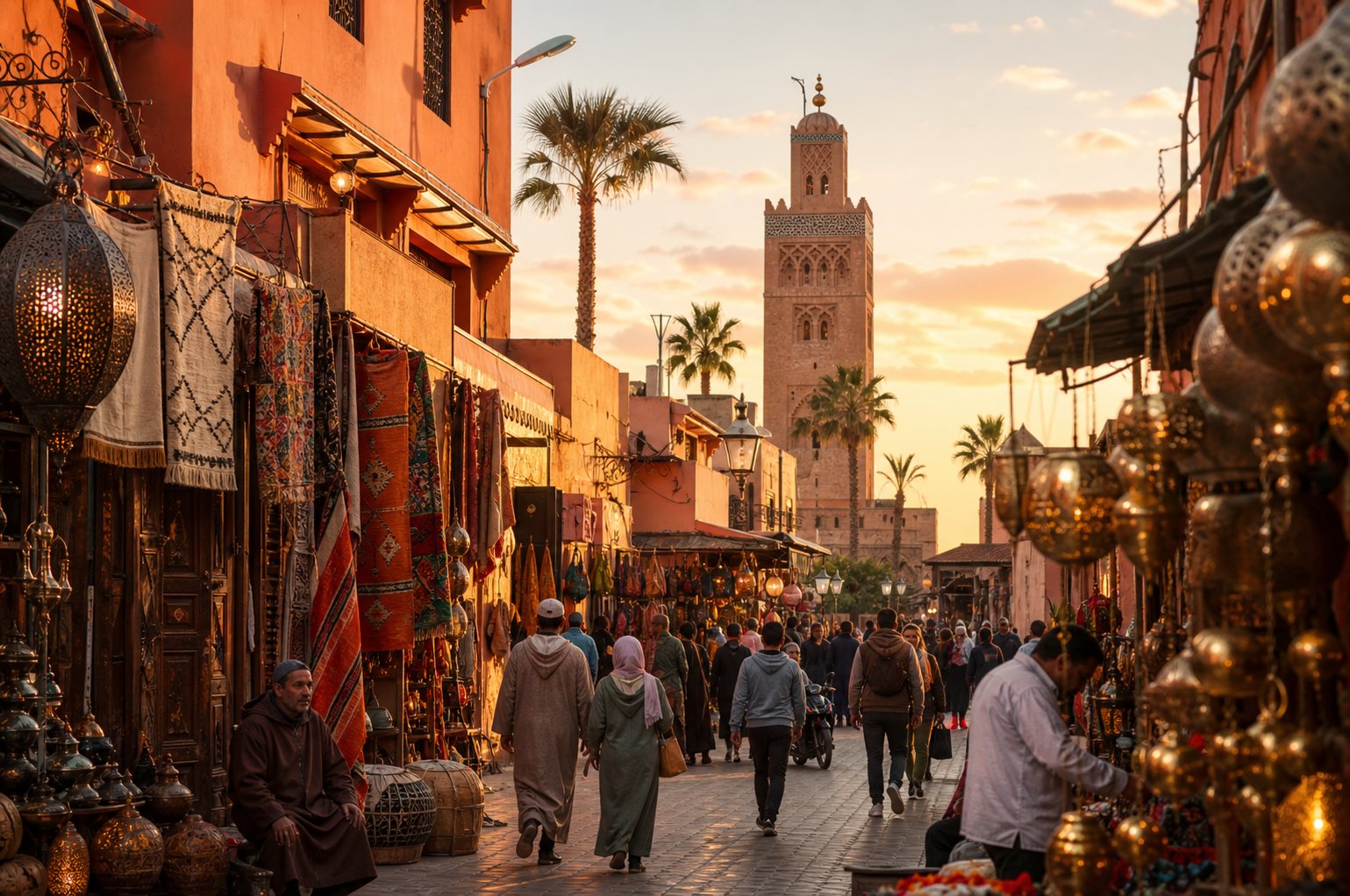
Morocco's craft traditions are among the richest in the world — zellij tilework, polished tadelakt plaster, vegetable-tanned leather, hand-knotted carpets, blue Fes pottery, hammered brass, fragrant thuya woodwork, embroidered babouches and pierced lanterns. Each is rooted in a particular city and quarter, passed down through guilds and families. This guide maps the crafts to the places — and to the artisan souks and fixed-price Ensemble Artisanal complexes where you can see and buy them.
In this guide
Zellij: the geometry of tile
Zellij (or zellige) is the mosaic of hand-cut glazed terracotta tiles that covers fountains, floors, walls and the bases of minarets across Morocco. Each small piece — a star, a chevron, a fragment of a polygon — is cut by hand from a fired, glazed tile and set face-down into a geometric pattern of dizzying complexity, the mathematics of which has fascinated scholars for centuries. Fes is the historic heart of zellij, and the craft is also strong in Meknes and Marrakech.
You'll see masterwork zellij at the Bou Inania and Attarine medersas in Fes, the Saadian Tombs and Bahia Palace in Marrakech, and the Hassan II Mosque in Casablanca. The skill lives in the maâlem (master craftsman) and the cutters who shape each piece with a sharp hammer — a trade that still takes years to learn.
Tadelakt: polished lime plaster
Tadelakt is the lustrous, waterproof lime plaster that gives Marrakech's riads, hammams and bathrooms their seamless, stone-smooth walls. Applied in layers, compacted and burnished with a smooth river stone, then sealed with black (olive-oil) soap, it produces a surface that is both water-resistant and softly reflective — historically used precisely because it suited the damp heat of the hammam. Marrakech is its traditional home.
Because tadelakt is a surface technique rather than an object, you experience it more than you buy it — in the walls of your riad, the curve of a hammam, the lip of a basin. Some artisan shops sell small tadelakt vessels and tealight holders, and high-end workshops will apply it to commission.
Leather and the tanneries
Morocco's leather is legendary, and the tanneries of Fes — Chouara above all — are among the country's iconic sights: a honeycomb of stone vats where hides are still cured and dyed by hand using methods little changed in centuries (the famous note of pigeon droppings in the curing process is real). Marrakech has its own working tanneries in the Bab Debbagh quarter. The smell is powerful; sprigs of mint are traditionally offered at the viewing terraces, which belong to the surrounding leather shops.
The leather becomes babouches (slippers), poufs, bags, belts, jackets and bound books. Fes leather is generally the benchmark for quality; Marrakech offers huge variety. Inspect stitching and suppleness, and remember the terrace view comes with a sales pitch — pleasant to engage with, easy to decline.
Carpets, pottery and the regional clays
Carpets are a craft tradition in their own right — woven by women across the Atlas and the south, from plush cream Beni Ourain to colourful Azilal and bright Taznakht pieces (covered in depth in the dedicated rug-buying guide). They are sold everywhere but the weaving heartlands are the rural Atlas, with Marrakech and Fes as the main marketplaces.
Pottery splits by city. Fes is famous for its cobalt-blue-on-white faience and fine zellij tiles, fired from local grey clay. Safi, on the Atlantic coast south of Casablanca, is the country's pottery capital, with a whole hillside of kilns producing both traditional polychrome wares and the green-glazed pieces associated with the town. Salé (near Rabat) and Tamegroute in the south — with its distinctive green-glazed earthenware — round out the regional traditions. Look for even glazing and clean rims.
- Fes: blue-and-white faience and the finest zellij.
- Safi: the pottery capital — polychrome and green-glazed wares.
- Tamegroute: rustic green-glazed earthenware from the southern oasis.
- Salé & Meknes: established regional pottery and tilework.
Metalwork, wood and the wearables
Brass and copperware — hand-hammered trays, teapots, and the pierced lanterns that throw lacework shadows — are a Marrakech and Fes speciality; the Place des Ferblantiers in Marrakech is the traditional lantern-makers' square. Quality shows in the weight of the metal and the evenness of the piercing; lightweight tin substitutes rust where brass and copper last.
Woodwork centres on two timbers: fragrant cedar, carved into doors, screens and furniture (Fes is the historic centre), and thuya (thuja) burl, the richly grained aromatic root-wood unique to the Essaouira region, turned into boxes, bowls and inlaid pieces. Essaouira's marquetry workshops are a highlight. Add to these the embroidered leather babouches found nationwide, hand-pierced lanterns, woven baskets and palm-frond work, and the silver jewellery of the south (Tiznit is the silver town), and you have the core of Morocco's wearable and decorative crafts.
Where to see and buy: souks, quarters and the Ensemble Artisanal
Crafts in Morocco are organised by quarter. The medinas group trades together — the dyers' street, the coppersmiths' square, the leather lanes, the potters' quarter (in Fes, around Ain Nokbi) — so wandering the souks is itself a tour of the makers, and you can often watch artisans at work in tiny open-fronted workshops. The Marrakech and Fes souks are the great marketplaces; Essaouira concentrates thuya woodwork and marquetry; Tiznit, silver; Safi, pottery.
If the bargaining of the souk isn't for you, every major city has an Ensemble Artisanal — a government-supported craft complex where artisans work and sell at fixed, marked prices (no haggling). Quality is reliable and provenance clearer, and prices give a useful baseline to compare against the souks even if you buy elsewhere. Co-operatives — for argan oil, rugs and some pottery — work similarly, though it's worth checking that a 'cooperative' is the real thing rather than a shop using the label. Whichever you choose, watching a craft being made is often the most memorable part of the purchase.
- Ensemble Artisanal: fixed-price, no-haggle craft complexes in Marrakech, Fes, Rabat, Casablanca and other cities — reliable quality and a price benchmark.
- Souk quarters: trades cluster (coppersmiths, dyers, potters, lantern-makers) — wander to watch artisans at work.
- Specialist towns: Essaouira (thuya wood), Tiznit (silver), Safi (pottery), Fes (zellij, leather, blue pottery).
- Co-operatives: good for argan, rugs and some pottery — verify the label is genuine.
Frequently asked
What are Morocco's most famous crafts?
Zellij tile mosaic, tadelakt polished plaster, vegetable-tanned leather, hand-knotted carpets, pottery (blue Fes faience, Safi wares), hammered brass and copper, cedar and thuya woodwork, embroidered babouches, pierced lanterns and southern silver jewellery. Each is rooted in a particular city and artisan quarter and passed down through families and guilds.
Where are the famous Moroccan tanneries?
The most famous are in Fes — the Chouara tannery above all, a honeycomb of stone dyeing vats worked by hand for centuries. Marrakech also has working tanneries in the Bab Debbagh quarter. The viewing terraces belong to the surrounding leather shops, so a sprig of mint and a sales pitch usually come with the view — easy to enjoy and easy to decline.
What is the difference between zellij and tadelakt?
Zellij is mosaic made of hand-cut glazed terracotta tiles set into geometric patterns — you see it on fountains, floors and walls, with Fes as its heart. Tadelakt is a smooth, waterproof polished lime plaster burnished with a stone and sealed with black soap, traditionally used on Marrakech riad and hammam walls. One is cut tile; the other is a seamless plaster surface.
What is an Ensemble Artisanal?
A government-supported craft complex found in most major Moroccan cities where artisans work and sell at fixed, marked prices with no haggling. Quality is reliable and provenance clearer, making it ideal if bargaining isn't for you — and the prices give a useful baseline to compare against the souks even if you ultimately buy elsewhere.
Which Moroccan city is best for which craft?
Fes for zellij, fine leather and blue-and-white pottery; Marrakech for lanterns, leather and carpets; Essaouira for fragrant thuya woodwork and marquetry; Safi for pottery; Tiznit for silver jewellery; and Marrakech again for tadelakt plasterwork. Carpets come from the Atlas weaving regions and sell mainly through the Marrakech and Fes souks.
Planning a trip?
Let a Marrakech atelier handle the details.
Tell us your dates and style and we'll send a written itinerary and a transparent quote within 24 hours.
Request an itineraryKeep reading
Culture
Shopping in the Souks: What to Buy, Fair Prices & Tips
Morocco's souks are among the world's great shopping experiences — but they reward preparation. Knowing what to look for in rugs, leather, ceramics, lanterns and argan products, what fair prices look like, and how to bargain and ship makes the difference between a satisfying haul and buyer's regret.
Culture
Moroccan Carpets & Rugs: A Buyer's Guide
A Moroccan rug is often the most memorable thing a traveller brings home — and the purchase that causes the most anxiety. Understanding the main weaving traditions, how to tell hand-knotted wool from machine-made synthetic, how natural and chemical dyes differ, and how the gentle theatre of bargaining works lets you buy with confidence — or walk away relaxed and empty-handed, which is entirely fine.
Culture
Moroccan Souvenirs: What to Buy & Where
The best souvenirs from Morocco are things made there, by Moroccan hands, that you will actually use at home — not plastic camels. From hand-knotted Berber rugs and Fes leather to argan oil, hand-painted ceramics and thuya wood, here is what to buy and where to find the real thing.
Culture
A Guide to Moroccan Architecture & Decorative Arts
Moroccan architecture is a language of courtyards, fortresses and dazzling surface decoration. From the inward-looking riad and the earthen kasbah to zellij tilework, tadelakt plaster and carved cedar, this guide explains the building types and decorative arts you'll see across the medinas, palaces and southern oases.