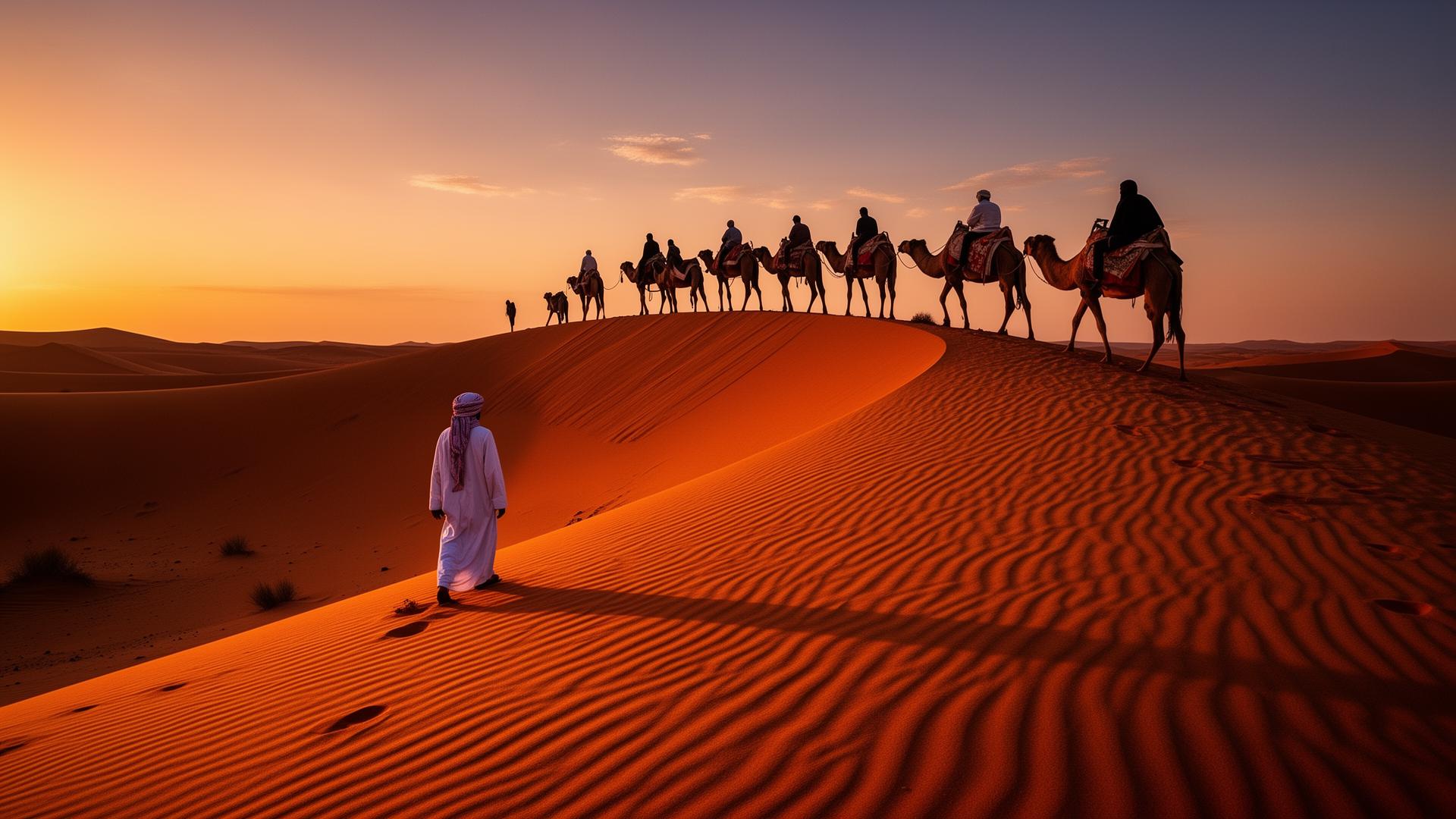
The ramparts and city walls
A full circuit of Taroudant's 7.5 km of Saadian earthen walls — best by bicycle, calèche (horse-drawn carriage) or on foot at dawn, when the ochre turns gold and the Atlas ridge is still clear.
Souss Valley · Anti-Atlas foothills
Taroudant is the 'little Marrakech' of the south — a walled Saadian city of ochre ramparts and souks in the Souss plain.
Best time
October–April (summer heat is intense; January–February sees saffron and almond blossom)
Recommended
1–2 nights
Airport
Agadir-Al Massira (AGA) + 1h drive
Region
Souss Valley · Anti-Atlas foothills
Taroudant sits in the broad Souss plain at the foot of the High Atlas, about 80 km east of Agadir and 230 km south of Marrakech. Its Saadian-era ramparts — some 7.5 km of terracotta walls pierced by five gates — are among the best-preserved in Morocco, and the city earns its nickname 'little Marrakech' for its lively souks, tanneries and foundouks in an atmosphere far quieter than the original. The surrounding Souss valley produces Morocco's finest argan, almonds, saffron and citrus; the Jbel Sirwa — a 3,304 m volcanic massif to the north-east — is the starting point for multi-day rose-valley treks.
What to see
A full circuit of Taroudant's 7.5 km of Saadian earthen walls — best by bicycle, calèche (horse-drawn carriage) or on foot at dawn, when the ochre turns gold and the Atlas ridge is still clear.
Two distinct market quarters — the Arab souk for spices, textiles and leather, the Berber souk for craft items, silver jewellery and raw argan — with very little of the tourist pressure found in Marrakech.
A 17th-century Glaoui kasbah, now a guesthouse, surrounded by a large date-palm oasis 37 km east of town — the backdrop for several French-language films shot in the region.
The volcanic massif north-east of Taroudant — a quiet 5–7 day traverse through Berber villages, rose gardens and almond groves, ending at the Draa Valley — one of Morocco's most rewarding off-the-beaten-track treks.
Itineraries
Every itinerary below is privately operated, fully customisable, and includes a deep stop in Taroudant. Click any tour for the day-by-day plan, the map, dates and pricing.
Before you go
Concierge
Tell us your dates, group size and pace. We'll send back a written proposal within 24 hours — private guides, transfers, riads, the lot.
Request a proposal →FAQ
The comparison rests on the earthen ramparts, the active souks and the ochre tones — Taroudant feels like a smaller, calmer, much less touristy version of the imperial city. It shares the same Saadian historical period and the same Souss cultural roots, but operates at a fraction of Marrakech's pace.
Strongly yes if you have a day or more. It's an hour from Agadir and gives you a completely different Morocco — a living walled city with authentic souks rather than a beach resort.
Yes — the P2017 over the Tizi n'Test (2,092 m) is one of Morocco's great mountain roads, winding through the High Atlas with spectacular views and the Tin Mal mosque en route. It requires a confident driver on mountain roads; we always use a local driver for this route.
October to April, when the heat is manageable and the Atlas is snow-capped. January and February bring almond blossom in the surrounding valleys; the saffron harvest is in November.
Read more
Stories, guides and practical tips to help you plan your time in Taroudant and beyond.