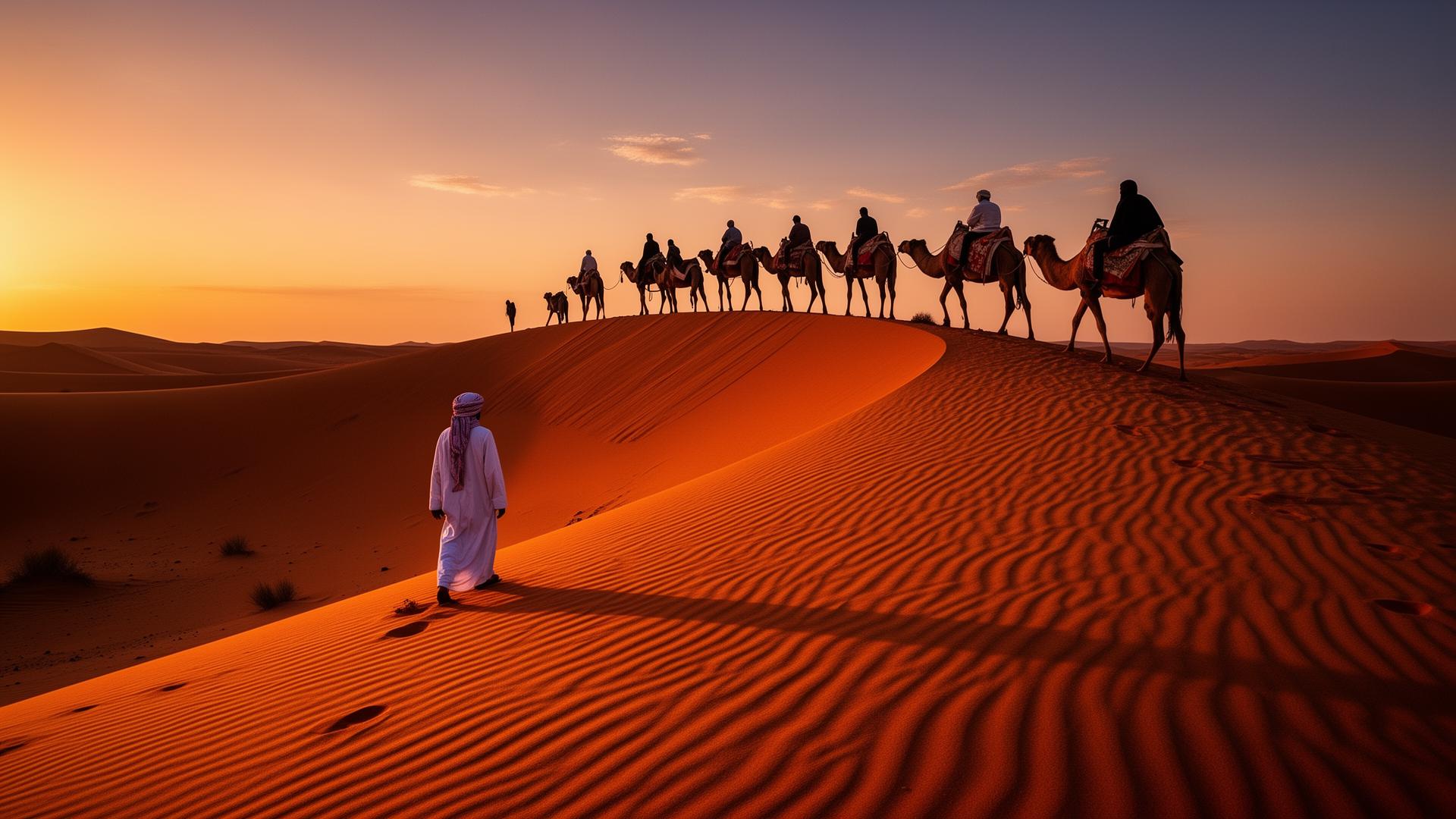
The Road of a Thousand Kasbahs runs south and east from Ouarzazate through the Dadès and Draa valleys — past Skoura, the Valley of Roses, Boumalne Dadès and the great gorges — a landscape of fortified earthen kasbahs and palm oases that most travellers drive on the way to the Sahara.
In this guide
What the route is
The Road of a Thousand Kasbahs is the popular name for the southern Moroccan route, centred on Ouarzazate, that strings together the fortified mud-brick kasbahs and ksour of the Dadès, Draa and surrounding valleys. It is not a single signposted highway but a corridor of roads through the pre-Sahara, where for centuries caravans crossed between the desert and the cities to the north.
Most travellers join it after crossing the High Atlas from Marrakech over the Tizi n'Tichka pass, then follow it east toward the gorges and on to the dunes of Merzouga, or south down the Draa toward M'hamid and Erg Chigaga.
Kasbahs and ksour: the architecture
The defining sight along the route is earthen architecture built from pisé — rammed earth and mud brick, often the same red-brown colour as the surrounding land. A kasbah is a fortified house or citadel, typically with corner towers and decorated upper walls; a ksar (plural ksour) is a fortified village of several families. The most famous is Aït Ben Haddou, a UNESCO World Heritage Site, but the route is dotted with dozens more in varying states of repair.
These buildings are beautiful but fragile: earthen walls need constant maintenance and erode quickly once abandoned. Many have been restored as guesthouses, while others stand as evocative ruins above the palm groves.
Along the way: oases, roses and gorges
East of Ouarzazate, Skoura is known for its palm oasis and the much-photographed Kasbah Amridil. Further on, Kelaat M'Gouna and the Valley of Roses produce the rose harvest celebrated each spring, with rosewater and rose products sold locally. Boumalne Dadès opens the way into the Dadès Gorges, with their folded rock formations and switchback road, while the nearby Todra (Todgha) Gorge is a dramatic canyon with sheer walls popular for short walks and climbing.
- Skoura — palm oasis and Kasbah Amridil.
- Kelaat M'Gouna / Valley of Roses — rose harvest and rosewater (spring).
- Boumalne Dadès — gateway to the Dadès Gorges.
- Todra (Todgha) Gorge — a deep canyon north of Tinghir.
- The Draa Valley — a long ribbon of palmeries toward M'hamid.
Driving it en route to the desert
For most travellers the Road of a Thousand Kasbahs is the scenic journey to the Sahara rather than a destination in itself. A typical pattern leaves Marrakech, crosses the Tizi n'Tichka, visits Aït Ben Haddou and overnights near Ouarzazate, then follows the kasbah road east through Skoura, the Dadès and Todra gorges, and on to the dunes of Erg Chebbi at Merzouga for a desert night.
The roads are paved and scenic but the distances are real — it is several hours between the main stops, and the gorges add detours. Two days from Marrakech to Merzouga is comfortable; rushing it in one is a very long day. Many travellers do this stretch with a private driver, which frees them to stop for photographs, kasbahs and viewpoints along the way.
Frequently asked
Where is the Road of a Thousand Kasbahs?
It runs through southern Morocco, centred on Ouarzazate, following the Dadès and Draa valleys east and south through Skoura, Kelaat M'Gouna, Boumalne Dadès and the gorges toward Merzouga and the Sahara. It is a corridor of scenic roads rather than a single named highway.
What is the difference between a kasbah and a ksar?
A kasbah is a fortified house or citadel, usually with corner towers, while a ksar (plural ksour) is a fortified village housing several families. Both are built from earthen pisé — rammed earth and mud brick — and both line this southern route.
How long does it take to drive the Road of a Thousand Kasbahs?
From Marrakech to Merzouga via Ouarzazate, the kasbah road and the gorges, two days is comfortable with an overnight near Ouarzazate or in the Dadès. It can be done faster, but the distances are long and the scenery rewards a slower pace.
Planning a trip?
Let a Marrakech atelier handle the details.
Tell us your dates and style and we'll send a written itinerary and a transparent quote within 24 hours.
Request an itineraryKeep reading
Planning
Things to Do in Ouarzazate: The Essential Guide
Ouarzazate — 'the door of the desert' — sits at the junction of the High Atlas and the Saharan south. It is the gateway to Aït Ben Haddou, Africa's most famous film set, and the Drâa Valley; its Atlas Studios produce more major films than almost anywhere outside Hollywood.
Practical
Marrakech to Merzouga: Routes, Times & Transport Options
Merzouga and the Erg Chebbi dunes are roughly 550 km from Marrakech — a long journey whichever way you go, but one of the most rewarding drives in North Africa. Here are all the options, the route differences, realistic timings and how to choose.
Itineraries
Morocco Road Trip Guide: Routes, Tips & What to Expect
A Morocco road trip is one of the great drives of the world — the High Atlas passes, the kasbah road, the Drâa Valley palm oases and the Saharan pre-desert unfold in sequence. Here is how to plan it, what the roads are actually like and which routes reward a self-driver.