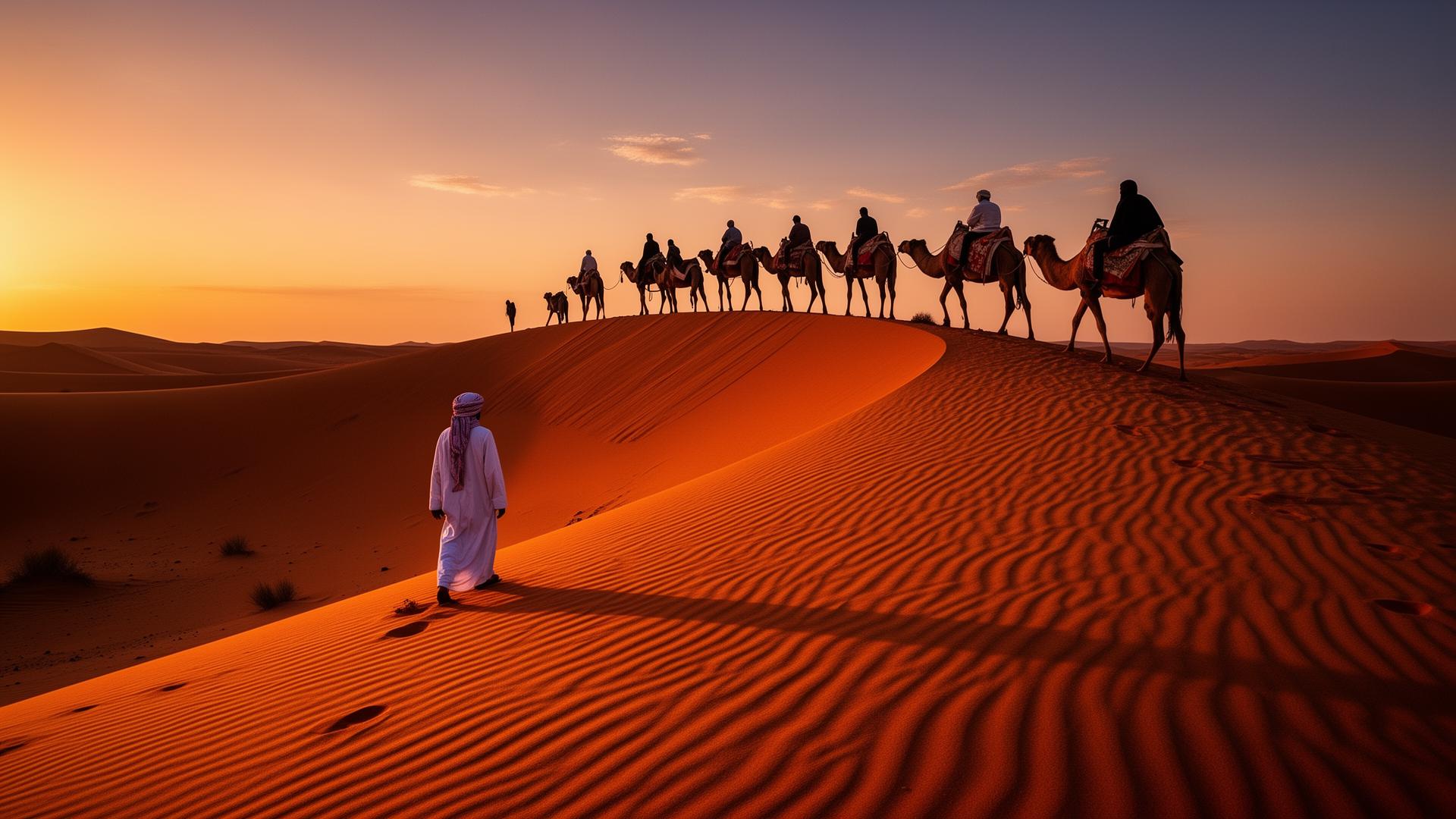
Morocco rewards travellers who stop to look up and out: red Sahara dunes catching the first light, a High Atlas pass folding away to the horizon, a medina rooftop at the call to prayer, a gorge wall glowing at dusk. This is a roundup of the country's finest viewpoints and panoramas — grouped by type, with notes on the best light and which are free and which expect you to order a tea.
In this guide
Desert: the great dune panoramas
The signature Moroccan panorama is the Sahara at dawn. At Erg Chebbi near Merzouga, the dunes rise as much as roughly 150 metres above the surrounding hammada, and the half-hour around sunrise is when the sand turns from grey to deep apricot-red and the long shadows carve the ridgelines. Climb the nearest high dune behind camp before first light — the effort is real in soft sand, but the 360-degree sweep of glowing crests at sunrise is the view people travel across the world for.
Further south and west, Erg Chigaga beyond M'hamid is wilder and far less visited — a broader, lower sea of dunes reached only by 4x4, with the same transformative dawn and dusk light and almost no crowds. For a panorama over the desert's edge rather than within it, Jbel Zagora — the hill above the town of Zagora — gives a wide view over the palm groves of the Draa valley, traditionally climbed for sunset.
- Best light: the hour after sunrise and the hour before sunset; midday flattens the dunes.
- Erg Chebbi (Merzouga) — climb the dune above your camp before dawn.
- Erg Chigaga (M'hamid) — remoter, emptier, 4x4 access only.
- Jbel Zagora — sunset hill over the Draa palmeraie; mostly free to walk up.
Mountains: High Atlas passes and peaks
The drive between Marrakech and Ouarzazate crosses the Tizi n'Tichka, the High Atlas road pass that tops out at roughly 2,260 metres. The laybys near the summit open onto vast layered ridgelines and Berber villages clinging to the slopes — one of the great accessible mountain panoramas in the country, and free to anyone who stops the car. The neighbouring Tizi n'Test pass, narrower and more dramatic, offers similar long views toward the Souss plain for those taking the western route.
For walkers, the Toubkal massif holds North Africa's highest summit (Jbel Toubkal, roughly 4,167 metres), and the climb — typically two days from Imlil via the refuges — delivers a summit panorama over a sea of Atlas peaks. Closer to Marrakech and far gentler, the Kik Plateau is a high tableland on the way to the mountains with sweeping views back toward the Atlas wall, and the Ourika valley running up to Setti Fatma gives a green, waterfall-fed mountain panorama within an easy day trip of the city.
- Tizi n'Tichka (~2,260 m) — roadside panorama on the Marrakech–Ouarzazate road; free.
- Jbel Toubkal (~4,167 m) — two-day trek from Imlil; summit views over the High Atlas.
- Kik Plateau — easy high tableland near Marrakech looking back at the Atlas.
- Ourika valley & Setti Fatma — green valley and waterfalls, an easy day from Marrakech.
Medina rooftops: cities from above
Morocco's medinas are best understood from the roof. In Marrakech, the rooftop cafés and restaurants around the Jemaa el-Fnaa look out over the square's swirl of stalls and smoke toward the Koutoubia minaret — spectacular at sunset and in the blue hour, though these are cafés, so expect to order a mint tea or a meal for the view. In Fes, the classic panorama of the whole bowl-shaped medina is from the hillside above the city: the Borj Nord (a 16th-century fortress, now an arms museum) and the nearby Merinid Tombs sit on the northern slope and take in the entire sea of rooftops, best in the soft light of late afternoon as the call to prayer rises across the city.
Chefchaouen's signature view is from the Spanish Mosque, a small hilltop chapel a short uphill walk east of the medina: from there the whole blue-washed town spreads out below against the Rif mountains, and the spot is free, public and especially lovely at sunset. Almost every city rewards a climb — Tangier's kasbah terraces over the strait, Rabat's Kasbah of the Udayas over the river mouth, and the minaret-studded skyline of any imperial city seen from a riad terrace.
- Marrakech — rooftop cafés over the Jemaa el-Fnaa and Koutoubia; a café, so order something.
- Fes — Borj Nord and the Merinid Tombs hillside over the full medina; free public hillside.
- Chefchaouen — the Spanish Mosque hill over the blue city; free, best at sunset.
Gorges and valleys: walls of rock and palm
East of Ouarzazate, the Dades and Todra gorges are the two great canyon panoramas of the south. The Dades is famous for the twisting hairpin road that switchbacks up the gorge wall — there is a well-known viewpoint café at the top of the bends looking back down the serpentine — while the Todra narrows to a sheer cleft where limestone walls rise up to around 300 metres on either side of a shallow river, most dramatic in the late morning when sun reaches the canyon floor.
Two valley panoramas are worth planning around. The Ziz valley viewpoint on the road south toward Errachidia and Erg Chebbi opens suddenly onto a ribbon of date palms threading green through bare ochre cliffs — a classic stop on the way to the desert. And Aït Ben Haddou, the fortified earthen ksar on the old caravan route, is best seen as a whole from the opposite bank of the river or from the hill behind it, glowing gold in the late afternoon — a UNESCO World Heritage site and one of Morocco's most photographed panoramas.
- Dades gorge — the hairpin-bend viewpoint over the switchback road.
- Todra gorge — sheer walls up to ~300 m; best when midday sun reaches the floor.
- Ziz valley viewpoint — palm-oasis ribbon on the road to the desert.
- Aït Ben Haddou — view the whole ksar from the far riverbank in late afternoon.
Coast: ramparts and the meeting of two seas
On the Atlantic, the ramparts of Essaouira — the Skala de la Ville, the old sea bastion with its line of Portuguese-era cannons — give a windswept panorama over the crashing surf, the Îles Purpuraires offshore and the white-and-blue medina behind. It is free to walk the main ramparts, and the light is best in the late afternoon as the sun drops toward the sea. Near Tangier in the far north, Cap Spartel stands on the headland where the Atlantic Ocean meets the Mediterranean Sea; the lighthouse terrace looks out over the symbolic meeting of two seas, and the nearby Caves of Hercules add a famous sea-cut window in the rock.
- Essaouira ramparts (Skala de la Ville) — Atlantic surf and the island; free, best at sunset.
- Cap Spartel (near Tangier) — the headland over the meeting of two seas.
Frequently asked
What is the best viewpoint in Morocco for sunrise?
The dunes of Erg Chebbi at Merzouga. Climb the high dune above your desert camp before first light and watch the whole sea of sand turn from grey to glowing red as the sun comes up — it is the country's defining panorama.
Where is the best view over Fes?
From the northern hillside above the medina — the Borj Nord fortress and the nearby Merinid Tombs both look out over the entire bowl of the old city. Go in the late afternoon for the warmest light and the rising call to prayer.
What is the famous viewpoint in Chefchaouen?
The Spanish Mosque, a small hilltop chapel a short uphill walk east of the medina. It is free and public, and frames the whole blue town below against the Rif mountains — at its best around sunset.
Are Morocco's best viewpoints free?
Many are — the Tizi n'Tichka laybys, the Chefchaouen Spanish Mosque hill, the Fes hillside tombs, the Essaouira ramparts and the desert dunes cost nothing. The exceptions are the medina rooftop cafés (in Marrakech especially), where the view comes with the expectation that you order a tea or a meal, and a few sites such as the Borj Nord museum that charge a small entry fee.
Which High Atlas pass has the best roadside panorama?
The Tizi n'Tichka on the Marrakech–Ouarzazate road, topping out at around 2,260 metres, has well-placed laybys near the summit with vast views over the layered ridgelines and Berber villages — all free to anyone who stops.
Planning a trip?
Let a Marrakech atelier handle the details.
Tell us your dates and style and we'll send a written itinerary and a transparent quote within 24 hours.
Request an itineraryKeep reading
Culture
Morocco Photography Guide
Morocco is among the world's great photography destinations: extraordinary light, vivid colours, ancient architecture and a landscape that shifts from blue city lanes to red dunes within a day's drive. Knowing where to go, when, and how to engage respectfully makes all the difference.
Planning
Things to Do in Chefchaouen: The Essential Guide
Chefchaouen — Morocco's famous blue city tucked into the Rif Mountains — is more than a photography backdrop. Its medina is small, walkable and genuinely beautiful; its mountains reward hikers; its food is distinctively Rifian; and its pace is the slowest in the country.
Planning
Trekking the Atlas Mountains: Toubkal, Imlil & Beyond
The High Atlas rises to 4,167 metres at Jbel Toubkal, North Africa's highest peak. Whether you want a single-day walk from Imlil, a multi-day village traverse or a summit attempt, the Atlas rewards it — with the right season, guide and preparation.
Planning
Sahara Desert Tour Guide: Merzouga, Chigaga & Zagora
Three Saharan gateways compete for Morocco's desert travellers: Erg Chebbi at Merzouga for accessibility and grandeur, Erg Chigaga near M'Hamid for remoteness, and Zagora for a shorter excursion. Here is how to choose, what the camps are like, and when to go.