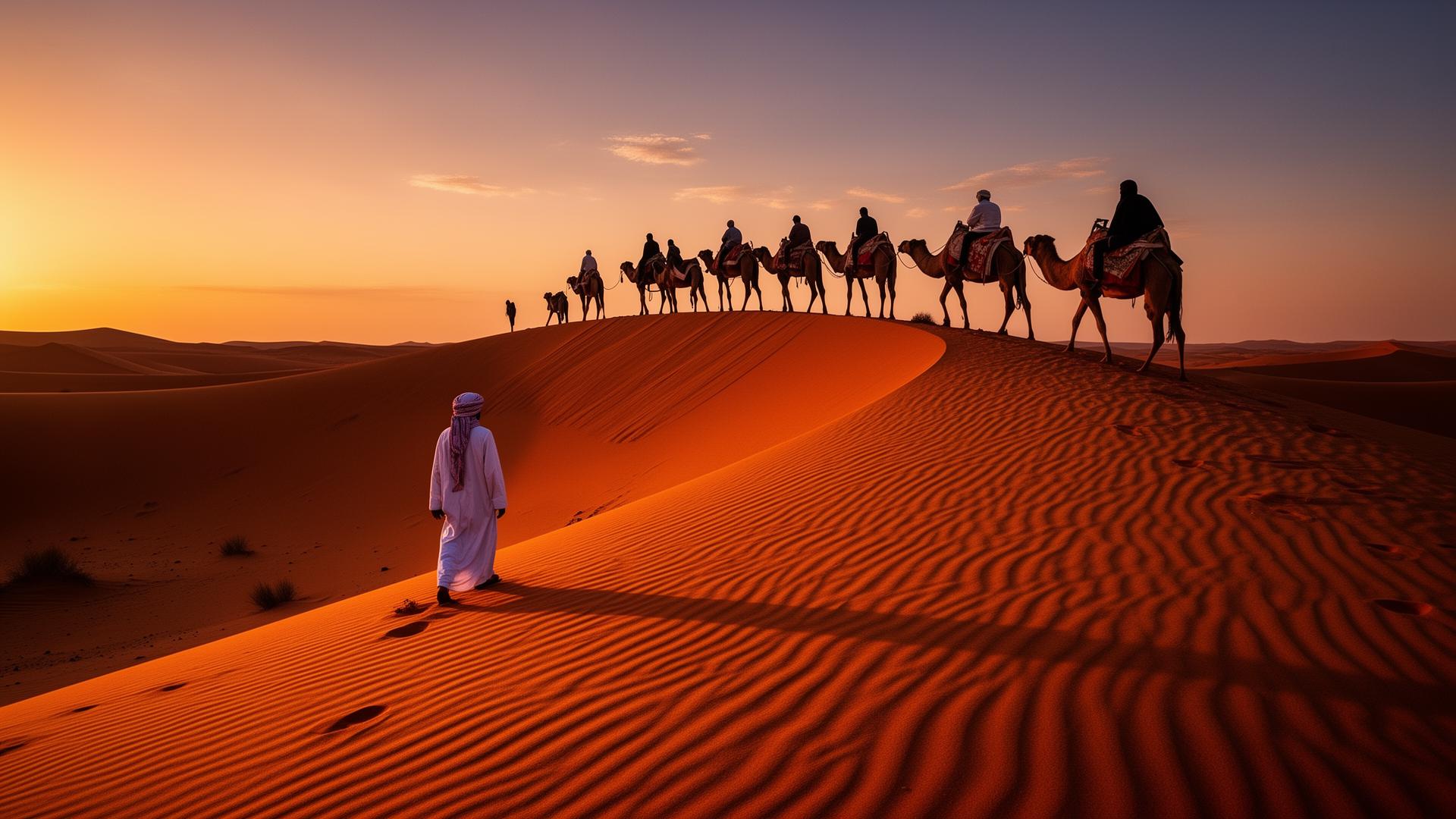
Few countries pack such radical landscape contrast into a single itinerary as Morocco. Within a six-hour drive of Marrakech you can stand atop Jbel Toubkal — North Africa's highest peak at 4,167 m — or watch the sun rise over 150-metre orange dunes at Erg Chebbi near Merzouga. The two landscapes are not competitors so much as complements, but most travellers with limited time must prioritise one. The Atlas Mountains rise immediately south of Marrakech: the High Atlas contains dozens of Berber villages, the Ourika Valley, Imlil trekking base and Toubkal summit. The Sahara requires a full journey — 9 to 10 hours by road or a short domestic flight — to reach Merzouga's Erg Chebbi, Morocco's most dramatic dune sea. The Middle Atlas is a third mountain option, greener and cedar-forested, closer to Fes. Each landscape has its own rhythm, its own difficulty level and its own rewards.
Option A
Sahara Desert (Erg Chebbi / Merzouga)
Africa's most iconic dune landscape — camel treks, stargazing and silence
Best for
Bucket-list seekers, photographers, romance travellers, adventure lovers
Full guideOption B
Atlas Mountains (High Atlas / Toubkal)
North Africa's highest range — trekking, Berber villages and mountain passes
Best for
Hikers, trekkers, culture enthusiasts, travellers preferring cooler climates
Full guideSide-by-side breakdown
Sahara Desert (Erg Chebbi / Merzouga) vs Atlas Mountains (High Atlas / Toubkal): how they compare
| Category | Sahara Desert (Erg Chebbi / Merzouga) | Atlas Mountains (High Atlas / Toubkal) |
|---|---|---|
| Effort to reach from Marrakech | High — 9–10 h drive or domestic flight to Merzouga (Erg Chebbi) | Low — Imlil (Atlas trekking base) is 1.5 h from Marrakech |
| Physical demand | Low — camel trek and camp stay require no fitness; dune walks are short | Variable — day hikes easy; Toubkal summit (2 days) demands good fitness |
| Climate | Extreme — summer days exceed 45°C; perfect October–April | Pleasant — cool year-round; snow on Toubkal November–April |
| Iconic experience | Overnight in a Saharan camp; sunrise on the dunes; Milky Way stargazing | Sunrise from Toubkal summit; mule trek through Berber villages; Ourika Valley |
| Cultural encounters | Berber desert communities; nomad camps; ancient ksar (fortified villages) | High Atlas Berber (Amazigh) villages; traditional imdlawn granaries; weekly souks |
| Time needed | Minimum 2 nights to justify the journey; 3 nights ideal | 1 day for Ourika Valley; 2–3 days for Toubkal summit; 4–5 days for a full traverse |
| Best for photographers | Golden dunes at sunrise/sunset; camel silhouettes; starry night skies | Snow-capped peaks; terraced fields; kasbahs framed by mountain walls |
| Cost | Higher — long drive or flight; guided camp tours from $120/person/night | Lower — Imlil day trip from $40; guided Toubkal trek from $80/day all-in |
Our verdict
Which should you choose?
Choose the Sahara if your Morocco trip has one non-negotiable bucket-list moment — sleeping under the Milky Way in a Berber desert camp with dunes at the door is an experience that is hard to replicate anywhere else on Earth. Choose the Atlas Mountains if you prefer active exploration, cooler temperatures, genuine Berber village culture, and the freedom to reach extraordinary scenery in an afternoon from Marrakech. If time allows, do both: a 10-day circuit from Marrakech can take you into the Atlas foothills on days 2–3, south through the Draa Valley to the Sahara for days 5–7, and back via the Dadès and Todra gorges.
Deep dives
Explore each destination in full
FAQ
Frequently asked questions
How far is the Sahara from Marrakech?
The closest Saharan dunes to Marrakech are Erg Chebbi near Merzouga — approximately 560 km by road, a journey of 9 to 10 hours. The most popular option is a guided 3-day tour that breaks the journey in Ouarzazate and the Dadès Gorge. Domestic flights to Errachidia (90 km from Merzouga) cut travel time to around 2 hours total.
How far is the Atlas from Marrakech?
The High Atlas begins immediately south of Marrakech. Imlil — the main trekking base for Jbel Toubkal — is only 60 km from the city, around 1.5 hours by car. The Ourika Valley is even closer at 35 km. The Atlas is easily visited as a day trip or a two-night escape from Marrakech.
Is Jbel Toubkal difficult to climb?
Toubkal (4,167 m) is a non-technical ascent — no ropes or climbing equipment needed — but it is strenuous. Most hikers do it over two days: overnight at the Toubkal Refuge at 3,207 m, then summit at dawn. A good level of fitness and proper mountain gear are essential. Outside July–September, crampons and an ice axe are required.
What is the best time to visit the Sahara in Morocco?
October to April is ideal for the Sahara: daytime temperatures are comfortable (20–30°C) and nights are cold but endurable. Avoid July and August when temperatures exceed 45°C. March and April can bring Saharan wildflowers and occasional migratory birds to the dune edges.
Can I visit both the Sahara and the Atlas on one trip?
Yes — this is in fact the classic Morocco grand tour. A typical 10-day itinerary from Marrakech: Atlas foothills (Imlil/Ourika) days 2–3, cross the Tizi n'Tichka to Ouarzazate, through the Dadès and Todra gorges to Merzouga for 2 nights, then loop back via the Draa Valley. Most visitors do this with a private driver or guided tour.
Ready to book?
Let a Marrakech atelier build your itinerary.
Tell us which destinations you want to combine and we'll send a written itinerary and a transparent quote within 24 hours.
Keep comparing
All destination comparisons